
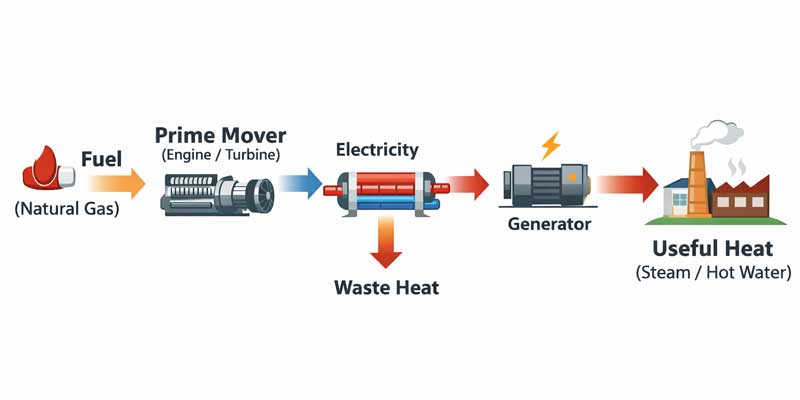
Combined Heat and Power, or CHP, is a system that produces electricity and useful thermal energy from a single fuel source. CHP improves efficiency by capturing heat that would normally be wasted in traditional power generation and using it for heating, hot water, or process loads. If you take one key point from this article, it is that CHP routinely achieves 60 to 80 percent total system efficiency because it uses both the electrical and thermal output. A standard generator or utility supply typically delivers only 30 to 50 percent efficiency because the heat produced during generation is lost to the environment.
Facilities that adopt CHP often see reduced fuel consumption, improved reliability, and lower emissions because they replace multiple separate systems with a single integrated system. E-Finity deploys natural gas microturbine and recip engine based CHP systems that operate continuously with ultra low emissions and very high availability. These characteristics make CHP an anchor technology for resilience-focused microgrids.
CHP in Plain Terms: Quick Definitions
Before going deeper, here are direct answers to the terminology questions readers ask most.
What is the full form of CHP?
CHP stands for Combined Heat and Power. It describes a single system that generates electricity and captures the heat produced during generation for useful purposes such as hot water, steam, or cooling.
Is CHP the same as cogeneration?
Yes. Cogeneration and Combined Heat and Power are interchangeable terms for the same concept: producing power and useful thermal energy from one fuel source. You will see both used across engineering, utility, and incentive documents.
What is trigeneration or CCHP?
Trigeneration, also called Combined Cooling, Heat and Power (CCHP), extends CHP by adding cooling. Recovered heat drives an absorption chiller to produce chilled water, so one fuel input delivers electricity, heat, and cooling.
Why does the terminology matter?
Incentive programs, permits, and utility interconnection rules often reference these exact terms. Knowing that CHP and cogeneration mean the same thing helps you match your project to the right rebate, tax credit, or tariff.
What CHP Actually Does and Why It Is Different From Traditional Generation
Conventional power generation wastes the majority of its fuel input as heat. A power only turbine or generator produces electricity, but the exhaust heat is vented and unused. CHP captures that heat and repurposes it as a valuable energy product. To do this, a CHP system routes hot turbine exhaust through a heat exchanger or heat recovery unit, producing hot water, steam, or thermal energy for absorption cooling.
The key difference is simple: CHP creates multiple useful energy streams from a single input. A traditional system creates only one. This structural difference explains why CHP consistently outperforms standalone boilers and standalone generators in total efficiency.
For example, consider a facility that uses separate systems for electricity and hot water. The generator may run at 35 percent electrical efficiency, and the boiler may run at 80 percent thermal efficiency. Combined, the total system efficiency ends up much lower because each unit uses fuel independently. CHP merges these two processes, raising overall efficiency and reducing total fuel usage.
How CHP Uses a Single Fuel Source to Deliver Two Outputs
A CHP system begins with a prime mover. This may be a natural gas microturbine, reciprocating engine, fuel cell, or turbine. Microturbines are particularly effective because they produce clean exhaust and maintain stable output even under varying load conditions. To do this, the turbine compresses air, injects natural gas, combusts the mixture, and spins a shaft to generate electricity.
The exhaust leaving the turbine remains extremely hot. CHP systems harness this heat through a heat recovery module. Depending on the facility’s needs, the recovered thermal energy can produce:
• Domestic or process hot water
• Low pressure steam
• High pressure steam for industrial processes
• Chilled water with the use of absorption chillers
This captured heat offsets what would normally be produced by separate boilers or heaters. It replaces fuel consumption that would have occurred elsewhere in the facility, which is why CHP reduces total energy expenses.
Why CHP Achieves Higher Efficiency: The Technical Basis
CHP improves efficiency because it increases the useful energy output of each fuel unit. To understand this, consider the three types of efficiency that matter:
• Electrical efficiency
• Thermal efficiency
• Total system efficiency
Electrical efficiency measures how much electricity is produced per unit of fuel. Thermal efficiency measures how much useful heat is recovered. Total system efficiency combines both.
A typical grid power source might have 33 percent electrical efficiency by the time electricity reaches the facility, especially when accounting for transmission losses. A microturbine CHP system might have 30-45 percent electrical efficiency on-site but can recover an additional 40 to 50 percent as thermal energy. Total system efficiency therefore reaches 70 to 80 percent.
To achieve this, engineers must size the heat recovery unit correctly. Oversizing leads to underutilized heat. Undersizing wastes potential recovery. The feasibility phase should include thermal load profiles to match the CHP output with real consumption patterns.
How CHP Lowers Emissions and Reduces Fuel Use
Emissions fall because CHP allows a facility to do the same amount of work with less total fuel. When electrical and thermal loads are met simultaneously, the facility avoids running inefficient boilers or pulling power from a distant grid with its own losses. To do this, the CHP system operates continuously, allowing the prime mover to maintain stable combustion, which further reduces emissions.
In many urban environments, natural gas microturbines operate with single-digit parts-per-million NOx output, often meeting strict air standards without aftertreatment. This is one reason CHP receives incentive support at both federal and state levels.
A manufacturing facility using 80 percent of its recovered heat can often reduce total fuel consumption by 20 to 40 percent compared to separate heat and power. This is a direct result of replacing two separate systems with one efficient unit.
What CHP Costs, How It Pays Back, and What Incentives Apply
Understanding how CHP works naturally leads to the next question: what does a combined heat and power system cost, and when does it pay for itself?
Installed cost for a CHP system is usually expressed in dollars per kilowatt of electrical capacity, and it varies with the prime mover, the complexity of heat recovery, and site conditions. As a general planning guide, reciprocating engine CHP tends to carry a lower installed cost per kW, while natural gas microturbine CHP typically costs more per kW but offers cleaner exhaust and lower maintenance demands. Smaller systems cost more per kW than larger ones because engineering, interconnection, and permitting are largely fixed regardless of size.
Payback is driven almost entirely by the spark spread — the difference between what you pay for grid electricity and what you pay for the natural gas the CHP system burns. A wide spark spread (expensive electricity, cheap gas) produces fast payback. A narrow spark spread erodes savings. Because CHP also displaces fuel you would otherwise burn in a boiler, the recovered heat adds a second stream of avoided cost on top of the avoided electricity.
To estimate payback in principle: add the annual value of electricity you no longer buy from the grid to the annual value of boiler fuel the recovered heat displaces, then subtract the annual cost of the gas the CHP unit consumes plus maintenance. Divide the net installed cost by that annual net savings to get a simple payback in years. The higher your run hours and the more of the recovered heat you actually use, the shorter that payback becomes — which is why facilities with steady, year-round thermal loads see the best returns.
Incentives can meaningfully shorten payback. Because these programs change and vary by location, confirm current eligibility before modeling a project.
- Federal Investment Tax Credit (ITC) — CHP property can qualify for the federal Investment Tax Credit, reducing net capital cost. Eligibility rules and credit levels change, so verify current terms and any capacity or efficiency thresholds.
- State and utility rebates — Many states and utilities offer capacity-based or performance-based incentives for CHP and cogeneration. Availability depends on your jurisdiction and utility territory.
- Spark spread economics — Payback improves as the gap between electricity and gas prices widens. Model your actual tariffs rather than national averages.
- Run hours and heat use — High operating hours and full use of recovered heat drive the strongest returns; underused heat lengthens payback.
CHP in Microgrids and Why It Improves Resilience
Microgrids require firm, stable power. Solar and storage alone may not support multi-hour outages or high thermal loads. CHP anchors a microgrid by providing continuous generation and heat recovery while batteries handle instantaneous transitions.
To do this, the microgrid control system dispatches the microturbine at baseload and engages storage for fast support. This combination enables seamless islanding. During outages, the CHP system carries the majority of load while recovered heat supports processes such as hot water, sterilization, space heating, or cooling.
One E-Finity project supporting a regional healthcare facility demonstrated this advantage. During outage simulations, the microturbine CHP system maintained critical electrical and thermal loads for the entire modeled event, while the battery supplied momentary ride-through. Had the facility relied on a boiler and separate generator, both systems would have required separate fuel, maintenance, and parallel operation under stress.
How to Evaluate Whether CHP Fits Your Facility
CHP delivers maximum value when electrical and thermal loads overlap. To determine whether CHP is a fit, analyze the following:
• Average and minimum baseload demand
• Thermal demand throughout the year
• Potential for hot water, steam, or cooling loads
• Hours of operation
• Fuel type and availability
• Emissions requirements
To do this, collect one year of interval load data for electrical consumption and build a matching thermal load profile. The engineering team should then match turbine sizing to baseload and heat recovery to thermal needs. A mismatch between heat output and thermal demand reduces efficiency gains.
CHP is a strong fit for facilities such as food processing plants, data centers with absorption chillers, hotels, hospitals, universities, manufacturing sites, and water treatment facilities.
When CHP Is Not the Right Fit: Honest Limitations
CHP is powerful, but it is not universal. Here are the conditions that weaken the case, paired with when the technology still makes sense.
| Low or seasonal thermal demand | If a facility has little year-round need for hot water, steam, or cooling, most of the recovered heat is wasted and payback suffers. CHP still fits if thermal storage or absorption cooling can absorb the heat, or if a summer cooling load offsets a lighter heating season. |
|---|---|
| Unfavorable spark spread | When electricity is cheap relative to natural gas, the savings that fund CHP shrink. CHP still makes sense where electricity is expensive, gas is stable, or resilience and emissions goals carry their own value beyond simple payback. |
| Maintenance and downtime | Reciprocating engines require more frequent maintenance intervals and scheduled downtime than microturbines, which have fewer moving parts. CHP remains viable when a maintenance and monitoring plan covers those intervals so availability stays high. |
| Natural gas price exposure | Because CHP economics depend on gas, a volatile or rising gas market introduces risk. CHP still fits facilities with predictable gas supply, favorable rate structures, or a strategic need for on-site generation independent of the grid. |
| Interconnection and permitting timelines | Utility interconnection studies and air-quality permitting can add months to a project. CHP is worth pursuing where the long-term operating savings and resilience justify the upfront process — and where low-emission microturbines simplify air permitting. |
How Heat Recovery Works in Practice
The heat recovery module is the engine of CHP efficiency. It extracts heat from the turbine exhaust and transfers it to a working fluid. This can take several forms:
• Water is heated directly for use in hydronic systems
• Heat is transferred to create steam
• Thermal energy powers absorption chillers for cooling
• Heat is stored in buffer tanks for load shifting
To do this correctly, engineers must map the exhaust temperature of the microturbine, the required thermal output, and the system’s return water temperature. The delta between these determines recovery potential.
A facility with stable hot water needs often achieves the highest thermal utilization rates. A facility with intermittent thermal loads may incorporate thermal storage so recovered heat is not wasted.