

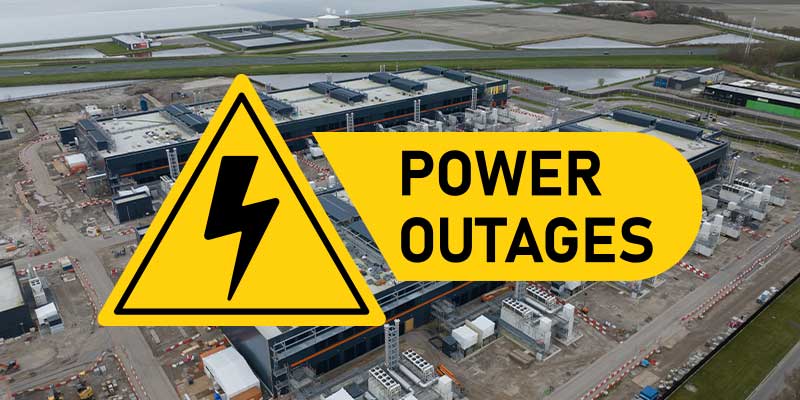
Power outages are one of the highest impact risks for data centers. The single most important takeaway is that most data center outages do not come from complete utility failures but from short disturbances lasting less than two seconds. These events are enough to cause IT load drops, equipment resets, or cascading cooling failures. Microgrids prevent these issues by supplying continuous onsite power with fast response capabilities, ensuring that essential systems remain online even when the grid falters.
The most effective prevention strategy is combining firm onsite generation such as natural gas CHP or microturbines with battery storage to supply instantaneous transition support. In E-Finity deployments, data center microturbine based microgrids have delivered uptime above 99.9 percent during disturbances that caused conventional generator systems to falter. The key is designing the microgrid so it carries critical baseload continuously, eliminating reliance on generator start times.
Why Data Centers Lose Power and How These Failures Occur
Data centers typically lose power from one of four causes:
• Voltage sags or dips
• Frequency disturbances
• Utility switching events
• Complete outages
A generator can handle full outages but cannot respond to voltage or frequency events fast enough. UPS systems cover milliseconds of interruption but cannot sustain long events or compensate for unstable grid conditions. To prevent these failures, a microgrid must supply stable baseload power and support the UPS during disturbances.
To do this, integrate a prime mover such as a natural gas microturbine or CHP unit that runs continuously. This eliminates generator start delays and reduces the burden on UPS batteries. Batteries then provide fast response support and handle the transitional moment if the grid collapses. By carrying baseload with CHP and supporting peaks with storage, the microgrid removes common failure points.
A recent study by the Uptime Institute found that 60 percent of data center outages caused direct financial losses, with 25 percent costing more than 1 million dollars. These outages frequently begin with micro-disturbances rather than full blackouts.
How Cooling Failures Create Hidden Outage Risks
Cooling failures are one of the most common secondary causes of data center shutdowns. Even a brief interruption can raise temperatures rapidly, especially in high-density environments. Loss of cooling can occur when pumps, chillers, or fans lose power, even for seconds.
To prevent this, design your microgrid to support both electrical and thermal loads. If the data center uses absorption chillers or heat-driven cooling processes, a CHP-based microgrid can support cooling even during grid loss. To do this, configure the heat recovery system to supply thermal energy consistently and pair it with a battery bank that maintains pump startup and fan transitions.
General scenario: a data center with 3 MW of IT load and a 2 MW cooling requirement experiences a voltage sag. The grid dips briefly, chillers stall, and UPS systems drain faster than expected. A microgrid carrying baseload prevents the collapse by keeping pumps and compressors online without relying on generator spin-up time.
When cooling stays online, downstream IT failure risk decreases dramatically.
Why Traditional Generators Are Not Enough
Backup generators play a role but cannot prevent the most common types of disturbances. Generators protect against full grid loss, yet their start times range from 5 to 15 seconds, depending on the facility and load sequencing. Voltage disturbances occur far more often than complete failures.
To improve resilience, the microgrid must eliminate the start-time window completely. This is done by running the onsite generation continuously. Natural gas microturbines are suited for this because they operate with very low maintenance requirements, minimal vibration, and can support islanding without interruption.
One E-Finity deployment for a mid-Atlantic data center demonstrated this advantage. During a utility switching event, the grid voltage dipped long enough for nearby facilities to experience IT load drops. The microturbine-backed microgrid maintained stable voltage and frequency throughout, and the facility reported zero impact on critical racks. Because the microgrid carried baseload continuously, no transfer sequence or generator startup was needed.
Designing a Microgrid to Prevent Data Center Outages
A microgrid for a data center must be engineered differently from general commercial microgrids. The priorities are continuous operation, seamless transitions, and stable power quality.
To do this, build your microgrid around five core components:
- Firm onsite generation sized for baseload
- Battery storage sized for transient support
- A UPS system that interfaces with the microgrid
- A control system that manages transitions automatically
- Protection schemes that isolate faults without disturbing internal loads
The critical engineering detail is synchronizing dispatch between CHP, batteries, and UPS systems. The microgrid must carry the majority of power continuously, preventing reliance on transfer switches or generator starting sequences.
For example, if the facility has a 5 MW IT load with a 2 MW cooling requirement, the microgrid might use a 4 MW CHP plant for baseload and 1 MW of batteries for instantaneous response. When a disturbance occurs, the battery covers milliseconds of transition, and the CHP system continues stable generation without interruption.
How Microgrids Improve Power Quality
Data centers require stable voltage, frequency, and harmonic conditions. Even minor deviations can trigger equipment faults. Microgrids improve power quality by acting as a buffer between the grid and the IT equipment.
To do this, configure your microgrid controls so they regulate voltage and frequency internally rather than relying on the utility feed. CHP and microturbines produce inherently stable output, and storage smooths fluctuations. This reduces reliance on UPS batteries for events outside full outages, extending battery life.
In typical installations, microgrid power quality reduces UPS cycling by 30 to 50 percent, which extends UPS lifespan and reduces replacement costs.
Cooling System Integration to Prevent Thermal Overruns
Cooling is as important as IT load. Data centers that ignore cooling integration often face thermal overruns during outages even if IT power is stable.
To prevent this risk, model cooling loads alongside electrical loads during the feasibility study. CHP can supply thermal energy that supports cooling via absorption chillers, reducing the electrical burden during outages. Batteries can support pump transitions and protect against short interruptions.
To do this correctly, gather data on:
• Pump startup loads
• Chiller sequencing
• Fan speed behavior during voltage dips
• Thermal inertia of the data hall
When cooling is integrated into the microgrid design, thermal runaway risks decrease significantly.
Interconnection and Protection Requirements
Data centers require precise interconnection and protection engineering because uncontrolled backfeed or improper islanding can cause severe equipment damage.
To design this correctly, the microgrid’s protection scheme must:
• Detect grid events instantly
• Open and close breakers in the correct sequence
• Maintain internal stability during isolation
• Prevent sympathetic tripping
• Support resynchronization when the grid returns
This level of engineering cannot be added after the fact. It must be part of the microgrid design so that protection relays, controls, and breakers operate in a coordinated manner.
Recommendations Based on Your Situation
If your data center experiences frequent voltage sags, prioritize a microgrid that operates continuously and supports UPS systems rather than relying solely on generator backup.
If your facility has high cooling density, integrate thermal modeling into the microgrid design and consider CHP to support cooling during outages.
If uptime is your top priority, select firm natural gas generation with battery support and require outage simulations that model voltage, frequency, and thermal load behavior.
If operational costs matter, evaluate the combined impact of CHP fuel savings, reduced demand charges, and lower UPS cycling.
If you want, I can produce another version focused on colocation data centers, hyperscale environments, Tier III and IV facilities, or multi-site operators.